


Corgi and MongoDB Bring YC Founders to One Table in New York
The founder ecosystem produces no shortage of stages, pitch sessions, and structured introductions. The conversations founders remember often begin after those formats disappear, when there is no audience to impress and no timer forcing the next slide.
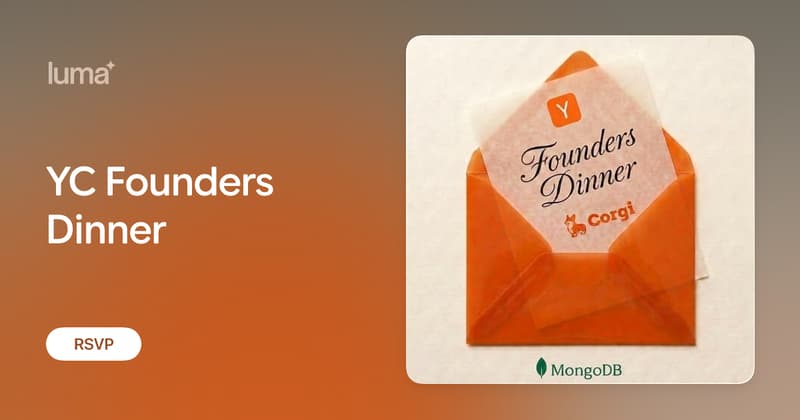
The YC Founders Dinner, hosted by Corgi and MongoDB on Friday, July 31, 2026, is built around that quieter layer of company building. The gathering brings Y Combinator founders in New York together for dinner and candid discussion about fundraising, operations, and the disorder of early-stage work.
The room is intentionally limited. Registration requires approval, the exact address is shared only with accepted attendees, and the event is specifically designed for YC founders building in New York. That makes the access boundary central to the product rather than a detail around it.
About the YC Founders Dinner
The dinner is positioned as an intimate founder gathering with no pitch decks and no formal stage. The official description emphasizes real conversation about building companies, raising capital, and navigating the operational pressure that arrives between public milestones.
Corgi is hosting the evening from its New York office with MongoDB. Corgi describes itself as an AI-native insurance carrier serving startups across directors and officers, cyber, errors and omissions, and general liability coverage.
That company context fits the room. Insurance becomes more relevant as startups hire teams, sign customers, raise institutional capital, and assume obligations that did not exist at the prototype stage. It is a category founders often postpone because the need becomes obvious only when an investor, enterprise buyer, landlord, or partner asks for proof.
MongoDB adds the perspective of a developer platform used by companies building data-intensive applications. Together, the hosts sit close to two kinds of infrastructure that become visible as a startup matures: the technical systems supporting the product and the risk systems supporting the company around it.
Why This Event Matters
Founder communities are often most valuable when they create a place to discuss what cannot be compressed into a public success story. Fundraising uncertainty, customer pressure, hiring mistakes, insurance exposure, founder conflict, and operating decisions rarely fit the tone of a demo day.
A dinner changes the incentive structure. There is less pressure to perform for a crowd and more room to compare experiences with people facing similar constraints. A founder can ask how another team handled a difficult board conversation, when it hired its first finance operator, which security request slowed an enterprise sale, or how the company prepared for diligence before a round.
Those questions are specific enough to be useful and sensitive enough that they benefit from trust. The goal is not to turn the table into a group therapy session. It is to create a room where the polished version of company building is not the only version allowed.
Why the YC Boundary Changes the Conversation
The Y Combinator boundary gives attendees a shared reference point. Participants understand the accelerator’s language, pace, fundraising environment, and alumni network. That does not guarantee that every conversation will be useful, but it reduces the amount of explanation required before founders can reach the substance of what they are building.
The narrower scope also allows the gathering to focus on New York. Building in the city comes with a particular mix of talent, customers, capital, operating costs, and industry access. Local founders can compare notes on the same market instead of treating geography as an abstract networking prompt.
The most valuable outcome may not be a transaction. It may be recognizing the founder who has already dealt with the problem that will land on someone else’s desk next month.
The Companies Behind the Dinner
Corgi brings an operating perspective centered on startup risk and insurance. Its AI-native positioning reflects a broader effort to make a traditionally slow, paperwork-heavy category more legible to fast-moving technology companies.
MongoDB brings the perspective of a developer platform with a large startup ecosystem. Young companies often build quickly on flexible infrastructure and then discover that scale introduces new requirements around performance, reliability, security, and cost.
Their participation reflects a broader pattern in startup communities. Infrastructure and service companies increasingly support founder events not only as sponsors, but as ecosystem participants that want to understand how companies are being formed and where operational friction is appearing.
The useful version of that relationship is reciprocal. Founders gain access to operators who understand common startup problems. The hosts hear, directly and without a survey, what teams are struggling to solve.
What Founders Should Bring to the Table
The official event removes the pitch deck, but it does not remove preparation. A useful dinner conversation begins with enough clarity to let others help.
Founders should be ready to explain what they are building, the stage of the company, and the operating question currently consuming the most attention. That question could involve a financing decision, an enterprise procurement hurdle, a technical tradeoff, a hiring plan, or a risk that is becoming difficult to postpone.
The best contribution is not a rehearsed success story. It is an observation another founder can use: what failed, what changed, which assumption proved wrong, or which process became necessary earlier than expected.
That posture turns a private dinner from a social reward into working infrastructure for the local founder network.
What This Signals
New York’s startup community is continuing to form smaller, more specific rooms inside the larger ecosystem. The value is shifting from broad attendance toward relevance, shared context, and the quality of the people around the table.
For YC founders, this dinner is less about collecting contacts than strengthening a local peer network that can remain useful after the plates are cleared. The event’s approval process, private location, and defined audience are all attempts to make that outcome more likely.
Event Details
- Official event: YC Founders Dinner
- Date: Friday, July 31, 2026
- Time: 7:00 PM to 9:00 PM EDT
- Location: Corgi office in New York City; exact address shared after approval
- Format: Private founder dinner
- Hosted by: Corgi and MongoDB
- Access: Y Combinator founders; registration requires approval
- Official page: Request to join on Luma
Frequently Asked Questions
Who is the YC Founders Dinner designed for?
The event is intended for Y Combinator founders building companies in New York City.
What kind of conversation is the dinner designed to create?
The format removes pitch decks and a formal stage so founders can compare candid experience across fundraising, operations, risk, and early-stage company building.
Who is hosting the dinner?
Corgi and MongoDB are hosting the event with individual hosts listed on the official registration page.
Where will the dinner take place?
The dinner will be held at Corgi's New York City office. The exact address is provided only to approved attendees.
Where the Money Moved
The intelligence briefing of the innovation economy — funding, M&A, debt and fund closes, read as market signal rather than deal announcements.
Subscribe on wherethemoneymoved.com