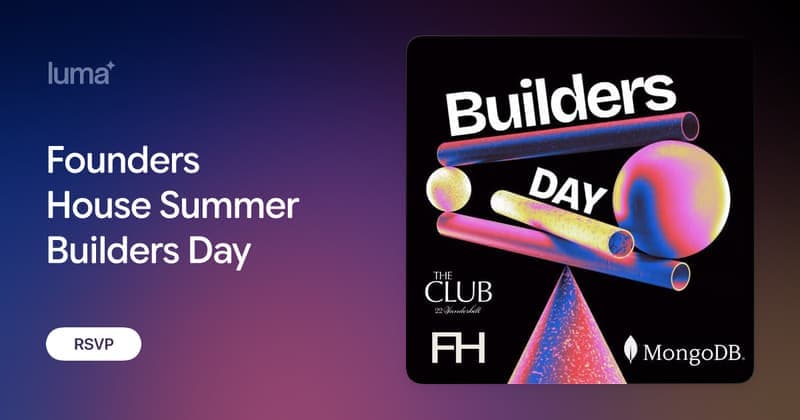
Founder communities become more useful when learning, building, pitching, and relationship formation happen in the same place.
Founders House Summer Builders Day, produced with MongoDB on Tuesday, August 25, 2026, brings those activities together for an afternoon at 22 Vanderbilt Avenue in New York. The program includes an AI and developer-tooling panel, hands-on breakout workshops, a founder pitch competition, and a closing terrace happy hour.
Registration is free but subject to approval. The format is designed for founders, technical builders, investors, and operators who want to participate in the work rather than attend another passive startup program.
About Summer Builders Day
The event begins with a technical panel focused on AI agents, developer tooling, and the changes founders need to understand as they build new products. Attendees will then move into hands-on breakout sessions covering AI building, large language models, and prompt engineering.
Five Founders House founders are scheduled to participate in a pitch competition later in the afternoon. The audience will hear the companies, provide feedback, and vote on the presentations before the event closes with cocktails, light bites, and networking on the seventh-floor terrace.
Founders House also offers visitors the option to spend more of the day in its space through coworking and wellness programming. That wider context is part of the community’s thesis: company building is not a single meeting but a practice that requires a place, a network, and enough personal capacity to keep making decisions.
The startup event market often separates technical learning from founder development. Builders attend one event for AI tooling, another for pitching, and another for networking.
Early-stage companies do not experience those challenges separately.
A technical decision affects the product story. The product story affects the pitch. The pitch reveals where the market does not yet understand the company. Feedback can send the founder back to the product with a better question.
Summer Builders Day is designed around that loop. The panel creates shared context. The workshops convert ideas into practice. The pitch competition tests whether the work can be explained. The happy hour gives participants a chance to continue the conversations that deserve more time.
The value is not that every attendee does everything. It is that the transitions between building, explaining, and learning become visible.
The Technical Layer
AI agents and developer tools are changing how early teams allocate work. A small company can prototype faster, automate internal tasks, and use infrastructure that would previously have required a larger engineering organization.
That leverage creates new questions. Founders need to know which parts of an agent workflow are reliable enough for production, how to evaluate variable behavior, where human review belongs, and whether the technical advantage will remain meaningful as models and tools become more available.
Hands-on breakouts are useful because those questions become clearer when builders move beyond the vocabulary. A prompt that works once is not a product. A working demo is not an operating system. The workshop environment gives participants a chance to inspect the distance between them.
The Pitch Layer
The pitch competition puts five Founders House companies in front of an audience that can respond immediately.
Audience feedback is not a substitute for customer evidence or investor diligence. It can still reveal where a story is confusing, which claim attracts attention, and whether the connection between problem, product, and market is strong enough to survive a short presentation.
The voting element adds energy, but the most valuable output may be the questions founders receive. A question repeated by several people is often a signal that the pitch has hidden an assumption or skipped a necessary piece of context.
Founders should leave with more than a score. They should leave knowing which sentence needs to become clearer and which product decision may need another look.
Founders House and MongoDB
Founders House describes itself as a work and wellness club for founders building at scale. Its model combines coworking, community programming, and wellness amenities in one New York location.
MongoDB brings a developer-infrastructure perspective to the event. The company is also promoting its startup program, which provides eligible teams with Atlas credits, Voyage AI tokens, technical expertise, and platform support.
The partnership gives Summer Builders Day both a physical community layer and a technical platform layer. One provides the environment where founders can work alongside peers. The other provides infrastructure and expertise that can help companies move from prototype toward a production system.
Work and Wellness as One Founder System
Founder wellness is often discussed after performance has already deteriorated. Founders House treats it as part of the operating environment.
That does not mean a class or amenity can remove the pressure of company building. It means the community is acknowledging that judgment, energy, and resilience affect product and leadership decisions.
The combination of coworking, wellness, technical education, and feedback makes a larger argument: founders need more than occasional inspiration. They need repeatable places where the work can continue.
What This Signals
Founder communities are becoming more intentional about the relationship between performance and sustainability. Founders House is positioning wellness, workspace, technical learning, and peer connection as parts of the same founder operating system.
Summer Builders Day reflects that thesis. Building a company requires more than access to information. It requires a place to test ideas, receive useful feedback, and remain connected to people working through similar uncertainty.
Event Details
- Official event: Founders House Summer Builders Day
- Date: Tuesday, August 25, 2026
- Time: 2:00 PM to 7:00 PM EDT
- Location: 22 Vanderbilt Avenue, New York, NY
- Format: AI panel, hands-on workshops, founder pitch competition, and terrace happy hour
- Hosted by: Founders House, Damian Tenuta, Louisa Li, MongoDB, and Max Kuivenhoven
- Access: Free; registration requires approval
- Official page: Request to join on Luma
 RSYNQ Raises $2M From Kanaden for Physical AI in Japan|Homa Raises $5M Seed for AI Homebuying and Mortgages|Origin Emerges With $20M Total for Construction Robots|
 Kutlerri.ai Raises $4M for Restaurant AI Sales Agents|
 AIsa Completes Seed Extension, Total Funding Tops $9M|Sharp Performance Raises $18M for First Responder Coaching|Molagri Announces $5.8M for Precision Biopesticides|Opsin Raises $21M for Enterprise AI Agent Security|Chariot Claims Raises $10M Series A for Consumer Arbitration|Sunbound Raises $24M Series A and Acquires Richter|