
Build with Gemma NYC Puts On-Device Healthcare AI to the Test
Healthcare AI has no shortage of promising demonstrations. The harder test is whether those systems can work inside the privacy, safety, and operating constraints of actual care environments.
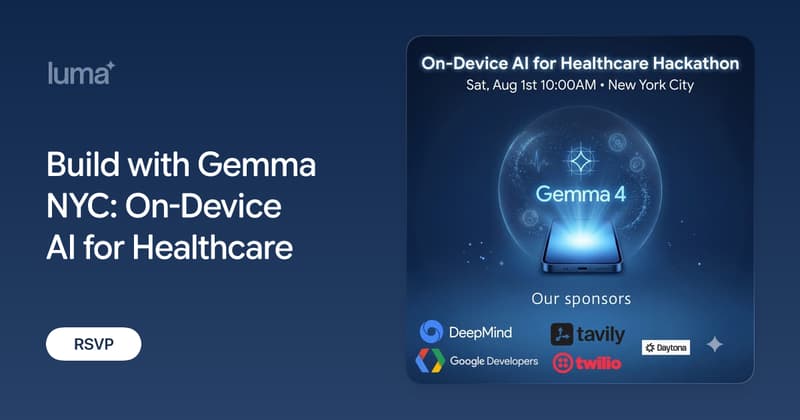
Build with Gemma NYC: On-Device AI for Healthcare brings that challenge into a one-day hackathon at One World Trade Center on Saturday, August 1, 2026. Organized through the Bond AI community and collaborators, the event asks builders to use Google’s open Gemma models to create working healthcare prototypes that emphasize local execution and carefully bounded use cases.
The event is currently full, but the waitlist remains open. That capacity signal reflects demand around a practical question: can smaller open models support useful healthcare workflows without sending every sensitive interaction into the cloud?
About Build with Gemma NYC
Participants will build across three tracks: Voice for Care, Agentic Care Copilots, and On-Device Private Health Tools.
Voice for Care includes ideas such as scribes, intake tools, triage support, reminders, and multilingual patient communication. Agentic Care Copilots focus on administrative work such as prior authorization, referrals, scheduling, and patient navigation. The on-device track centers on applications that can operate without sending sensitive patient data to a cloud service.
The boundaries are explicit. Projects may address decision support, documentation, navigation, accessibility, triage, and education. Diagnosis and treatment tools are outside the scope, and teams are instructed to use synthetic or public data.
Those limits do not reduce the technical challenge. They force teams to identify where AI can create practical value without turning a one-day prototype into an unsupported medical claim.
Why On-Device AI Matters in Healthcare
Cloud AI has become the default architecture for many applications because it gives builders access to powerful models and scalable infrastructure. Healthcare introduces reasons to consider a different balance.
Processing on the device can reduce how much sensitive information must leave the user’s environment. It can support workflows where connectivity is limited, lower latency for certain interactions, and give product teams more control over how data moves.
On-device execution is not a complete privacy strategy. A product can still collect information unnecessarily, expose data through logs, use unsafe defaults, or make outputs that people trust too quickly. Smaller models also introduce tradeoffs around capability, memory, and device resources.
The value is optionality. Builders can decide which tasks need a cloud model, which can run locally, and where the safest design is to avoid inference altogether. That architectural judgment is especially important when the user may assume that anything labeled “healthcare AI” carries clinical authority.
Why the Hackathon’s Scope Is the Product
Healthcare exposes the limits of casual AI product design. A useful system must account for privacy, workflow friction, clinical responsibility, data quality, accessibility, and the consequences of an incorrect output.
The event’s scope therefore matters as much as its model choice. By excluding diagnosis and treatment, the organizers direct builders toward operational and communication problems where experimentation can remain useful without pretending a prototype is a medical professional.
An intake assistant can help organize information while preserving a clear handoff to a person. A multilingual reminder tool can improve access without deciding what care someone needs. A prior-authorization copilot can reduce administrative work while leaving the final submission and accountability with the appropriate operator.
These are not glamorous boundaries, but they are the boundaries that make a product more credible.
The Builders, Judges, and Partners
The official event page lists judges and mentors spanning healthcare, AI engineering, consulting, and workflow automation. The judge lineup includes Margaux Benoit, Sharon Rao, Padam Kataria, Bonnie Cao, and Mina Abdulla. Mentors include Roshan Sharma, Margaux Benoit, and Meet Shah.
The event lists Tavily, Twilio, Cerebras, and Daytona as sponsors, with Celonis serving as the venue partner. The program includes a $2,000 prize pool distributed through Kaggle.
That partner mix gives teams access to search, communications, compute, development environments, and process expertise. The danger at any hackathon is using every available tool because it is available. The stronger teams will choose the smallest stack that proves the workflow while keeping the privacy and safety story understandable.
What a Strong Prototype Should Demonstrate
A winning healthcare AI demo should do more than produce an impressive answer.
It should define the user precisely, show the moment where the tool enters the workflow, and explain what happens when the model is uncertain or wrong. It should distinguish synthetic demo data from the requirements of production health information. It should also make clear which decisions remain with a clinician, administrator, patient, or caregiver.
Teams should be able to describe the failure mode in the same presentation as the capability. That is not a sign of weak ambition. It is evidence that the builders understand the environment they want to enter.
The event’s on-device emphasis creates another useful test: whether the product still has value when it cannot depend on an unlimited context window, permanent connectivity, or a remote model handling every step.
What This Signals
The healthcare AI market is beginning to separate impressive model behavior from deployable product design. Privacy, bounded scope, architecture, and workflow fit are becoming part of the product itself.
Events like Build with Gemma NYC matter because they force builders to confront those constraints before a prototype becomes a claim about healthcare transformation.
The event is full, but the waitlist and the final projects remain worth watching. The most important signal will not be which team adds the most AI. It will be which team demonstrates the best judgment about where AI belongs.
Event Details
- Official event: Build with Gemma NYC: On-Device AI for Healthcare
- Date: Saturday, August 1, 2026
- Time: Doors open at 10:00 AM EDT; winners scheduled for 5:30 PM
- Location: One World Trade Center, 285 Fulton Street, New York, NY 10007
- Format: In-person healthcare AI hackathon
- Prize pool: $2,000 through Kaggle
- Access: Event full; waitlist available
- Official page: Join the waitlist on Luma
Frequently Asked Questions
What will builders work on at Build with Gemma NYC?
Teams will build across voice-based care workflows, administrative care copilots, and private on-device health tools using Google's open Gemma models.
What safety boundaries apply to the projects?
Projects must use synthetic or public data and may not provide diagnosis or treatment. The scope is limited to decision support, documentation, navigation, accessibility, triage, and education.
Why is on-device AI relevant to healthcare?
Local execution can reduce how much sensitive information leaves the device, support limited-connectivity workflows, and give product teams another privacy-preserving architectural option.
Can people still attend?
The event is currently full, but interested builders can join the waitlist through the official event page.
Where the Money Moved
The intelligence briefing of the innovation economy — funding, M&A, debt and fund closes, read as market signal rather than deal announcements.
Subscribe on wherethemoneymoved.com