

Alex Dang’s AI Product Workshop Tests Founder Judgment
AI builders can now turn a credible idea into a working prototype before the product meeting has finished arguing about the name. That speed is real. So is the pile of AI products that solve a blurry problem, hide their edge cases behind a clean demo, and discover too late that technical possibility is not the same thing as customer demand.
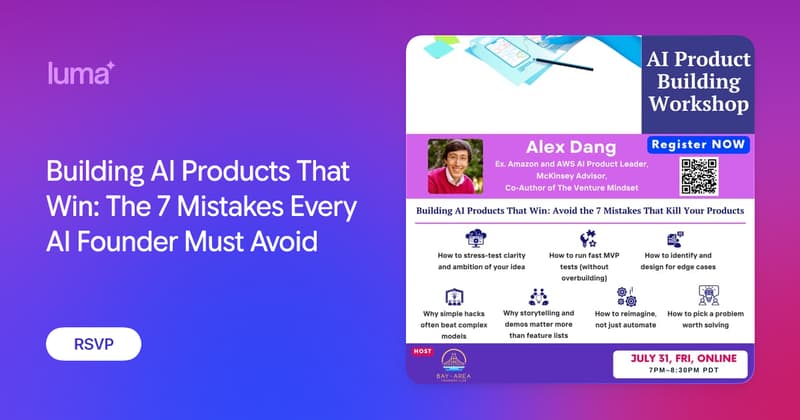
Building AI Products That Win: The 7 Mistakes Every AI Founder Must Avoid is a virtual workshop led by Alex Dang on Friday, July 31, 2026. Presented by the Bay Area Founders Club, the session focuses on problem selection, MVP testing, edge-case design, storytelling, product ambition, demonstrations, and the difference between reimagining a workflow and merely automating it.
Registration is now closed. That limits access to this particular session, but it does not reduce the relevance of its subject. AI product failure is increasingly a judgment problem rather than an access problem. Models, APIs, and development tools are widely available. The scarce advantage is knowing which problem deserves to be built around them.
About Building AI Products That Win
Building AI Products That Win is structured around 7 mistakes that can undermine an AI product before it earns meaningful adoption. The workshop asks founders to stress-test the clarity and ambition of an idea, run fast MVP tests without overbuilding, identify edge cases early, improve product storytelling, and create demonstrations that reveal actual value rather than theatrical polish.
The official event description makes one distinction especially clear: reimagining is not the same as automating. An AI feature can make an existing task faster while leaving the underlying workflow untouched. A stronger product asks whether the workflow should exist in its current form at all, which steps require human judgment, and where automation creates more risk than value.
That is a harder conversation than choosing a model or adding an agent. It is also the conversation that determines whether a product becomes part of a customer’s operating system or another tab they stop opening after the trial ends.
Why This Workshop Matters Now
The current AI market rewards visible movement. Founders are expected to ship, demonstrate, announce, and iterate at a pace that would have looked unreasonable a few years ago. The falling cost of development makes that pace possible, but it can also make weak assumptions look stronger than they are.
A polished prototype is persuasive because people can see it work. What they cannot immediately see is how often it fails, which inputs break it, whether a buyer will change behavior to use it, or how expensive the product becomes when it reaches production. Those questions arrive later, usually after the team has invested code, capital, reputation, and emotional attachment.
Alex Dang’s workshop sits inside that gap. It does not tell founders to move slowly. It argues for making speed more useful by pairing it with sharper product decisions. The important test is not whether a team can build a feature. It is whether the feature addresses a painful, repeated, and valuable problem with enough clarity to survive contact with customers.
The Seven-Mistake Frame Is Really a Decision System
Lists of startup mistakes can become fortune cookies for people with pitch decks. This workshop appears more practical because the topics form a decision system.
Problem selection establishes whether the opportunity matters. MVP testing determines which assumptions can be challenged before the team overcommits. Edge-case design exposes where trust can collapse. Storytelling helps buyers understand the value without requiring them to decode the architecture. Demonstrations connect the promise to observable behavior. Product ambition asks whether the team is creating a meaningful change or decorating an existing process with AI.
Together, those decisions move product discipline upstream. They make product thinking part of the engineering process rather than a cleanup exercise that begins after launch.
The Operator Behind the Workshop
The official event page identifies Alex Dang as a former Amazon and AWS AI product leader, a former McKinsey Partner, and co-author of The Venture Mindset. His work spans product strategy, AI, and innovation across startups and larger organizations.
That background gives the session an operating center. Building inside a large technology company, advising established organizations, and working with founders expose different versions of the same problem: teams can execute competently against an idea that was never framed well enough.
Bay Area Founders Club presents the workshop as part of a larger founder and investor community created by Dr. Paul Fang. The organization says it was founded in Silicon Valley in 2022 and has built a network spanning founders, startups, and venture investors. That audience makes product judgment a natural subject. Capital can accelerate a strong product thesis, but it can also help a weak thesis travel farther before reality catches it.
Who Should Pay Attention
The session is designed for startup founders and AI builders, but the underlying framework also matters to product leaders, technical founders, design partners, and early investors evaluating AI companies.
For a founder, the value is a better sequence of questions before committing the team. For a product leader, it is a framework for separating customer evidence from internal enthusiasm. For an investor, it is a sharper way to examine whether an AI company owns a durable workflow or simply has temporary access to impressive technology.
Registration being closed changes the immediate call to action. Readers cannot treat this article as a last-minute invitation. They can, however, follow Bay Area Founders Club for future sessions and use the workshop’s themes as a checklist for their own product reviews.
What This Signals for AI Founders
The first phase of the generative AI market was defined by access. Teams competed to reach powerful models, build integrations, and demonstrate capabilities that had recently seemed impossible. That advantage is narrowing.
The next phase will be defined by judgment. Strong teams will choose a meaningful problem, understand the user’s actual workflow, test the riskiest assumption early, design for failure, and communicate value without hiding behind model vocabulary.
AI development is becoming faster. That does not make product discipline less important. It makes every bad decision arrive sooner.
Event Details
- Official event: Building AI Products That Win: The 7 Mistakes Every AI Founder Must Avoid
- Date: Friday, July 31, 2026
- Time: 7:00 PM to 8:30 PM PDT, 10:00 PM to 11:30 PM EDT
- Format: Virtual
- Presented by: Bay Area Founders Club
- Hosted by: Dr. Paul Fang and Alex Dang
- Registration status: Sales ended and registration closed
- Official page: View the event on Luma
Frequently Asked Questions
What is Building AI Products That Win?
It is a virtual product-strategy workshop focused on 7 mistakes that can undermine AI products, including weak problem selection, overbuilt MVPs, missed edge cases, and unclear storytelling.
Who is leading the AI product workshop?
Alex Dang is leading the session. The official event page identifies him as a former Amazon and AWS AI product leader, former McKinsey Partner, and co-author of The Venture Mindset.
When and where is the workshop?
The workshop is scheduled for Friday, July 31, 2026, from 7:00 PM to 8:30 PM PDT. It is a virtual event.
Can people still register?
No. The official event page currently shows that sales have ended and registration is closed.
Where the Money Moved
The intelligence briefing of the innovation economy — funding, M&A, debt and fund closes, read as market signal rather than deal announcements.
Subscribe on wherethemoneymoved.com