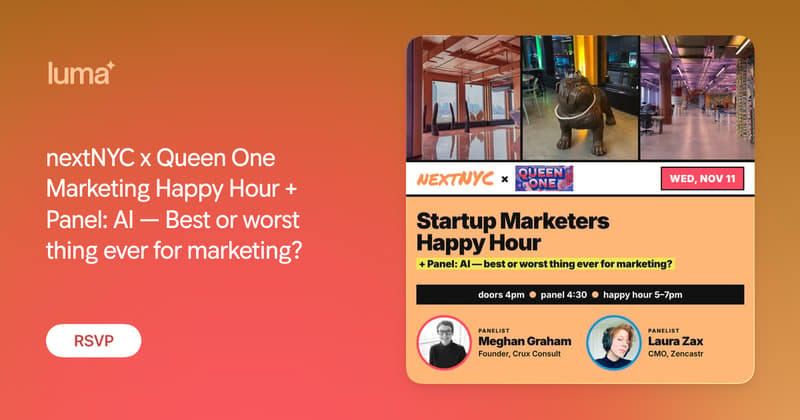
nextNYC and Queen One are bringing a marketing question to Brooklyn that deserves a careful answer: how should teams judge AI's contribution when making more material becomes easier? Their upcoming Marketing Happy Hour + Panel pairs a short discussion with time for marketers, founders and investors to compare operating choices.
Event listings place the gathering on November 11, 2026. The organizer names Laura Zax, CMO at Zencastr, and Meghan Graham, Founder of Crux Consult, as panelists; doors open at 4 PM ET, the panel begins at 4:30 PM, and the happy hour starts at 5 PM. Registration requires host approval, and the exact Brooklyn address is disclosed through registration.
The commercial stakes sit inside an ordinary management problem. When a workflow gets faster, a marketing leader still has to decide what deserves attention, what needs review and what result would justify doing more of it. The panel's announced focus on AI return and creative decisions gives that problem a specific place to be discussed before another tool becomes another standing expense.
What the nextNYC and Queen One panel will address
The official event description centers on AI's effect on marketing, including the tension between creative ambition and incremental optimization. That framing is useful because the two activities ask different things of a team. Improving an existing message requires a way to compare alternatives; deciding what a brand should say requires a view of the customer and the business that a comparison alone cannot supply.
Consider the choices a founder might bring into the room. A team could use AI to explore several directions, adapt existing material or accelerate production. Each choice creates a different review burden and a different definition of success. Counting finished assets would leave those distinctions out, even if the count looked impressive on a dashboard.
A useful conversation would make those choices visible. Which step became easier, who remained accountable for accuracy, and what did the customer do differently afterward? Those are editorial questions to bring to the panel, rather than promised answers from speakers who have yet to take the stage. They put the discussion close to a budget decision an operator can actually make.
Why the speakers' operating contexts matter
Laura Zax is listed by the organizer as CMO at Zencastr, which provides podcast and video recording, editing and publishing tools. That operating context places production and distribution close together. For a marketing audience, it offers a reason to listen for how creative intent survives the handoffs between an original conversation, an edited piece and the material eventually put in front of an audience.
The organizer identifies Meghan Graham as Founder of Crux Consult and describes the work in terms of storytelling and responsible use of emerging technologies. That adds another practical lens: choosing a message a brand can stand behind. The event listing establishes the role and participation; it does not establish a specific position Meghan Graham will take on the panel.
Together, those listed perspectives make the discussion relevant to the people who approve work as well as those who produce it. A founder might ask how to brief an experiment. A growth leader might ask when another variation stops teaching the team anything. A marketer might ask how much supervision a new workflow needs before time savings become usable capacity. The value will depend on how specific the conversation becomes.
How founders and marketers can prepare useful questions
The strongest preparation is a concrete workflow, with its constraints still attached. Choose a task the team already understands well enough to describe: the initial brief, the review process, the release decision and the customer response. Bringing that sequence into a conversation makes it easier to distinguish a helpful tool from a process that simply moves the difficult work to somebody else.
Time deserves the same discipline as spending. An hour saved in production can become an hour spent comparing outputs, correcting errors or waiting for approval. It can also become room for a better idea or a more thoughtful customer conversation. Those possibilities deserve separate treatment when a team decides whether an experiment should become routine.
For investors focused on consumer and marketing technology, the useful listening may happen in how operators describe the problem. A buyer explaining a stubborn review bottleneck is offering a different kind of information from a polished demonstration. Neither a panel nor a happy hour supplies an investment conclusion, but a precise account of the work can sharpen the next diligence question.
Brooklyn logistics and the conversation after the panel
The schedule gives the formal panel 30 minutes before the happy hour begins at 5 PM. That format creates room to continue a specific point with another participant, provided both people want the conversation. A useful follow-up could be as narrow as comparing how two teams define an acceptable draft or who signs off before a campaign goes live.
The evening gathering follows nextNYC's separate Pre-Series A Offsite earlier in the day. The two listings should remain distinct: readers interested in the marketing panel should use its own registration page. The public evening listing identifies Brooklyn and requires approval; it does not disclose a street address, so attendees should rely on the details supplied with their registration.
For a founder trying to connect marketing choices to the next operating plan, this is an opportunity to leave with a more precise question. How much review does the proposed workflow require, which creative decision still belongs to the team, and what evidence would earn the next allocation of time? The conversation in Brooklyn will have something useful to work with when those questions arrive carrying the particulars of a real business.
 Claimlane Raises €5.6M for Aftersales AI and US Growth|FluoRok Raises $30M for HF-Free Chemical Manufacturing|VÆRIDION Raises $33.7M Series A2 for Electric Microliner|Titan OS Adds $46M in Equity and Credit for TV Expansion|Hypersonica Raises €100M for European Hypersonic Development|Sentra Raises $150M Series C for AI Agent Data Security|Nyquis Raises $6.3M Seed for Grid Monitoring|
 nextNYC and Queen One Bring AI Marketing Debate to Brooklyn|Kabilio Raises €10M for AI Accounting and Client Software|Ravical Raises $17M Seed for Firm-Wide Accounting AI|
