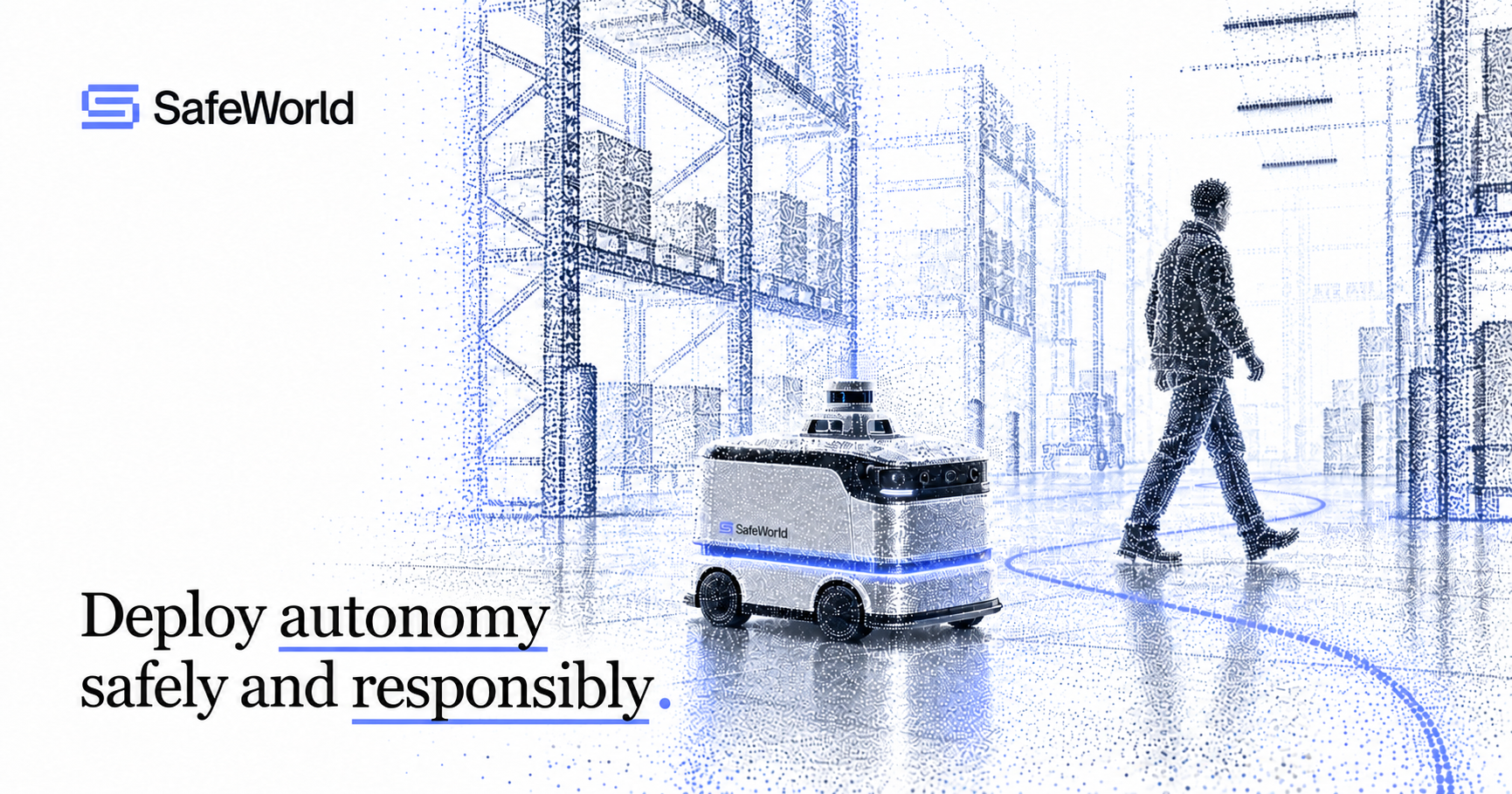


SafeWorld Raises $12.2M to Scale Robot Safety Testing
SafeWorld has raised a $12.2M seed round to build safety testing and simulation software for robots operating around people. Shine Capital and a16z Speedrun co-led the financing, with BoxGroup, Carnegie Mellon University Endowment, Innovation Endeavors, SV Angel, and other investors participating.
The Palo Alto company is working on a problem that becomes more expensive as robots become more capable: AI-powered machines can adapt to environments that were once too messy for traditional automation, but probabilistic behavior also makes every software version, sensor configuration, and workplace layout a new safety question. SafeWorld wants to turn those questions into repeatable tests before a worker has to encounter the failure in real life.
What SafeWorld Announced
SafeWorld emerged from stealth on October 5, 2026, with funding for a platform that helps robot developers and enterprise operators test dangerous or unusual human interactions in simulation. The company was founded in 2025 by Kyle Wong, Ding Zhao, and Simo Rachidi, a team spanning startup operations, autonomous-system safety research, cybersecurity, and production machine-learning infrastructure.
Kyle Wong is SafeWorld's co-founder and CEO. He previously founded Pixlee, an AI and user-generated-content platform acquired in 2022, and later served as CEO of StartX. Ding Zhao directs Carnegie Mellon University's Safe AI Lab, where his research examines trustworthy AI and safety for physical human-robot interaction. Simo Rachidi is SafeWorld's co-founder and CTO, bringing experience in machine learning, cybersecurity, autonomous systems, and large-scale data infrastructure.
The company lists Shine Capital and a16z Speedrun as co-leads. Its broader investor group includes BoxGroup, Carnegie Mellon University Endowment, Innovation Endeavors, SV Angel, Ovo Fund, Valkyrie, Zelda Ventures, Alpha Square Group, Founders Future, and Brave Capital. SafeWorld did not disclose a valuation, previous institutional financing, or a precise allocation of the new capital.
Why Robot Safety Testing Is Changing
Traditional industrial robots often work inside controlled spaces with movements that engineers can define in advance. Physical AI changes the operating model. A robot that perceives its surroundings and adapts its actions can work in warehouses, factories, hospitals, construction sites, and other human environments, but its behavior is harder to reduce to a fixed test matrix.
The dangerous cases are also the least responsible to reproduce around people. A worker may step from behind a cart, kneel in an unexpected place, carry an object that blocks a sensor, or fall into a robot's path. Lighting, clothing, body shape, equipment placement, and approach direction can all change what the robot perceives. Physical testing remains necessary, yet it is slow, expensive, and incapable of covering every combination on its own.
SafeWorld's technical approach begins with a defined task, hazard, requirement, scenario, measurement, and acceptance rule. Its software can generate controlled variations, place reactive human models inside simulated environments, run the robot's control system through those cases, and preserve the configuration and results. The goal is to make failures easier to discover, compare, and revisit after the software changes.
What Simulation Can and Cannot Prove
SafeWorld's strongest editorial distinction is also its most important commercial constraint: a simulation result is evidence about a defined test, not a universal declaration that a robot is safe. The company's own engineering guidance says a useful result must preserve the requirement, configuration, acceptance limit, measured outcome, excluded conditions, invalid runs, and known model limits.
That discipline matters because a perception model can detect a person while the larger system still reacts too late. A digital human can reproduce an occlusion pattern while failing to represent every real posture, sensor artifact, or physical response. SafeWorld explicitly says that simulation does not replace physical validation where the application or safety standard requires it.
The product therefore sits in a more credible position than a magic safety score. It can help teams expand coverage, create repeatable comparisons, and build a reviewable record across versions. Enterprise customers, insurers, regulators, and internal safety owners still have to decide whether that record is sufficient for a specific deployment.
The Early Commercial Signal
SafeWorld says it is already working with robotics companies and global enterprises. TechCrunch reported that Gritt Robotics is partnering with the company while developing robots for industrial-scale solar installation. Company-distributed announcement material also says SafeWorld is running pilots with multiple Fortune 50 enterprises across automotive manufacturing, medical devices, and warehouse automation, although those customers remain unnamed and the results have not been independently audited.
The company is also hiring across machine-learning software, full-stack engineering, simulation, functional safety, solutions engineering, marketing, and business development. That mix suggests SafeWorld is building both a technical evaluation system and the customer-facing work required to translate safety requirements into tests that enterprise teams can use.
Why Investors Are Funding the Evidence Layer
Robot capability attracts attention because it is visible. Safety infrastructure is easier to ignore until the machine has to leave a controlled demo and work beside a person. That handoff creates a market for tools that connect robotics engineering, safety ownership, operations, and deployment approval around the same evidence.
Shine Capital and a16z Speedrun are backing SafeWorld before the commercial model has fully settled. TechCrunch's reporting says the company is still determining how much of the offering will become a user-facing platform and how much will require services. That uncertainty is typical of early infrastructure markets where the product has to absorb customer-specific environments, safety practices, and integration work before the repeatable software boundary becomes obvious.
The $12.2M round gives SafeWorld time to find that boundary while expanding the number of scenarios, systems, and deployments it can evaluate. The company has also said it plans to develop and open-source research, benchmarks, and evaluation methods, which could help shape a shared vocabulary for evidence across robot builders and enterprise users.
What This Funding Changes
SafeWorld is not selling the absence of risk. It is selling a more systematic way to find, document, and revisit risk before it reaches the person sharing space with the machine. That is a harder promise to market than raw robot capability, but it may become the permission layer that capability needs.
The company's next phase will be judged by transfer: whether simulated failures predict useful real-world problems, whether engineering teams can incorporate the workflow without slowing deployment to a crawl, and whether buyers accept the resulting evidence as credible. Every new model version will create another test of that proposition, which gives SafeWorld a recurring job if it can make the record as useful as the simulation.
Frequently Asked Questions
Why does robot safety testing become harder with physical AI?
Physical AI systems can adapt to unstructured environments, so behavior may change across software versions, sensor configurations, workplace layouts, and human movement. That creates more rare but consequential scenarios than physical testing can safely reproduce on its own.
What does SafeWorld test?
SafeWorld builds simulated scenarios around defined robot tasks, hazards, requirements, and acceptance rules. Teams can vary conditions such as occlusion, lighting, posture, and approach, then preserve the configuration and results for engineering review.
Can simulation prove that a robot is safe?
No single simulation result proves complete field safety. SafeWorld's own technical guidance says the evidence applies to defined requirements and recorded conditions, while physical validation and broader system testing remain necessary where the application or safety standard requires them.
Why did investors back SafeWorld now?
More capable robots are moving into factories, warehouses, medical environments, and other workplaces where enterprise buyers need reviewable safety evidence. SafeWorld is building infrastructure intended to connect robot capability with the testing and documentation required for deployment decisions.
Where the Money Moved
The intelligence briefing of the innovation economy. Funding, M&A, debt and fund closes, read as market signal rather than deal announcements.
Subscribe to Where the Money Moved