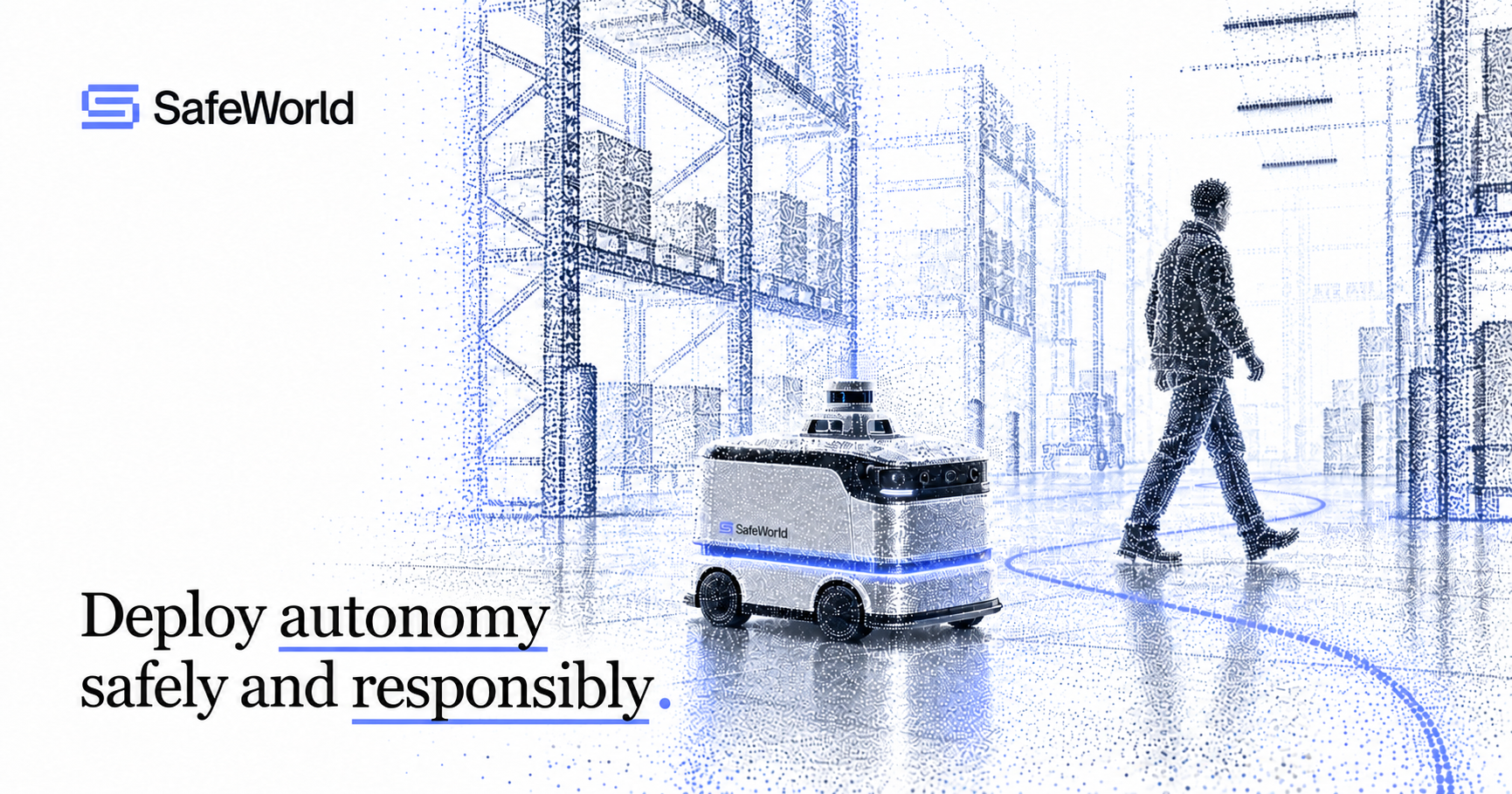


SafeWorld Is Building the Safety Layer for Physical AI
SafeWorld is a Palo Alto startup building safety testing and simulation software for robots that work around people. Founded in 2025 by Kyle Wong, Ding Zhao, and Simo Rachidi, the company is trying to turn unpredictable human behavior into repeatable engineering evidence before a machine reaches the factory floor, warehouse aisle, hospital corridor, or construction site.
Kyle Wong leads SafeWorld as CEO, Simo Rachidi serves as CTO, and Ding Zhao directs Carnegie Mellon University's Safe AI Lab. Their combined experience spans company building, machine learning, autonomous systems, cybersecurity, data infrastructure, and research into trustworthy physical AI.
SafeWorld matters because robot capability is moving faster than the evidence required to deploy it responsibly. A robot can perform beautifully in a controlled demonstration and still encounter a failure when lighting changes, a sensor is moved, a worker steps from behind a cart, or a software update alters its response. The company is building the testing layer that helps engineering and safety teams ask those questions before a person becomes the experiment.
About SafeWorld
SafeWorld was founded in 2025 to address a simple problem with difficult physics: robots are leaving cages and entering spaces designed for people. Traditional industrial automation often relies on prescribed motion inside controlled environments. Physical AI systems perceive, predict, and adapt, which expands what robots can do while multiplying the conditions that can change their behavior.
Kyle Wong previously founded Pixlee, an AI and user-generated-content platform acquired in 2022, and later served as CEO of StartX. Ding Zhao researches trustworthy AI and physical human-robot interaction at Carnegie Mellon University. Simo Rachidi brings experience across machine learning, cybersecurity, autonomous systems, and large-scale data infrastructure.
That founding mix fits the assignment. Robot safety is not only a research problem, a software problem, or an enterprise-sales problem. It is all three, usually in the same meeting, with an operations team asking whether the evidence will survive contact with a real workplace.
How SafeWorld tests robot behavior
SafeWorld's technical workflow begins with a defined task, hazard, requirement, scenario, measurement, and acceptance rule. Teams can turn incidents, system requirements, and robot logs into simulated tests, then vary conditions such as human movement, posture, occlusion, lighting, equipment placement, and approach direction.
The robot's control software runs through those cases while SafeWorld preserves the configuration and results. The useful output is not a dramatic animation. It is a record showing what requirement was tested, what changed, which runs were invalid, where the model stopped being representative, and whether a later software version actually improved the result.
SafeWorld is careful about the boundary. Simulation can expand coverage and make comparisons repeatable, but it does not prove complete safety, replace required physical validation, or certify an integrated robot system. That restraint strengthens the product thesis. Enterprise buyers do not need a magical score. They need evidence they can review, challenge, and revisit.
Why physical AI needs an evidence layer
The hardest robot failures are often rare, dangerous, and expensive to reproduce. A worker may fall into a robot's path, carry an object that blocks a sensor, or approach from an angle that a development dataset barely represented. Physical tests remain essential, but no responsible team can stage every human edge case at real-world scale.
Software creates another wrinkle. A new model, sensor configuration, workplace layout, or control-policy update can invalidate part of yesterday's confidence. Safety becomes a versioned workflow rather than a launch-day checkbox. SafeWorld is betting that the evidence surrounding each release will become as important as the capability inside it.
That position places the company between robot developers, enterprise safety owners, operations teams, insurers, and future regulators. Each group asks a different question, but all of them need a traceable answer before broader deployment can move from impressive to defensible.
Funding and early commercial signals
SafeWorld announced a $12.2M seed round on October 5, 2026. Shine Capital and a16z Speedrun co-led the financing. Other announced investors include BoxGroup, Carnegie Mellon University Endowment, Innovation Endeavors, SV Angel, Ovo Fund, Valkyrie, Zelda Ventures, Alpha Square Group, Founders Future, and Brave Capital.
The company says it is already working with robotics companies and global enterprises. TechCrunch identified Gritt Robotics as a development partner for industrial-scale solar installation. Company-distributed materials also describe pilots with unnamed Fortune 50 enterprises in automotive manufacturing, medical devices, and warehouse automation. Those are promising signals, but SafeWorld has not disclosed revenue, audited pilot results, a valuation, or certification outcomes.
The open commercial question is transfer. SafeWorld must show that simulated failures predict useful physical-world problems, that customers can incorporate the workflow without slowing deployment to a crawl, and that reviewers trust the resulting record. The financing buys time to prove that connection.
Leadership and the operating challenge
SafeWorld's three founders cover unusually complementary terrain. Wong understands company formation and enterprise trust. Zhao brings research depth in rare-event safety and human-robot interaction. Rachidi brings production machine-learning and infrastructure experience. The value is not in stacking biographies. It is in connecting research discipline with software that operators can use.
The company will also have to decide where software ends and services begin. Early safety programs are rarely neat. Customer environments, risk tolerances, robot architectures, and evidence requirements vary. The durable platform emerges when SafeWorld can absorb that complexity without turning every deployment into custom consulting.
SafeWorld has said it plans to open-source future research, benchmarks, and evaluation methods. If delivered, those resources could help the robotics ecosystem build a shared vocabulary for tests and evidence. For now, that remains a stated plan rather than a completed contribution.
Hiring is a market signal
SafeWorld's careers page shows openings across machine-learning software, full-stack engineering, simulation, functional safety, solutions engineering, marketing, and business development. That range reveals what the category demands.
The technical team has to model physical interaction, integrate robot-control systems, manage large scenario sets, and preserve reproducible results. The commercial team has to translate safety requirements into workflows that engineering, operations, and executive buyers can understand. A brilliant simulator that nobody can adopt is still a research project.
SafeWorld is hiring for the bridge between capability and permission. If physical AI keeps moving into human environments, that bridge may become one of the most valuable pieces of the robotics stack.
Frequently Asked Questions
What does SafeWorld do?
SafeWorld builds simulation and safety-testing software for robots operating around people. The platform helps teams create repeatable scenarios, vary operating conditions, and preserve evidence for engineering and deployment review.
Who founded SafeWorld?
Kyle Wong, Ding Zhao, and Simo Rachidi founded SafeWorld in 2025. Wong is CEO, Rachidi is CTO, and Zhao directs Carnegie Mellon University's Safe AI Lab.
How much funding has SafeWorld raised?
SafeWorld announced a $12.2M seed round on October 5, 2026, co-led by Shine Capital and a16z Speedrun. The company did not disclose a valuation or prior institutional financing.
Can SafeWorld prove that a robot is safe?
No single simulation proves complete robot safety. SafeWorld's testing can expand coverage and create repeatable evidence, while physical validation and broader system testing remain necessary where the application or safety standard requires them.
Is SafeWorld hiring?
Yes. SafeWorld's careers page lists opportunities across machine learning, full-stack engineering, simulation, functional safety, solutions engineering, marketing, and business development.
Where the Money Moved
The intelligence briefing of the innovation economy. Funding, M&A, debt and fund closes, read as market signal rather than deal announcements.
Subscribe to Where the Money Moved