
Euka Discloses $5M Seed for Omnichannel Creator Commerce
Euka AI disclosed $5M in previously raised seed funding on September 17, 2026, alongside the launch of an Instagram integration connected to Shopify fulfillment. The round was led by Susa Ventures and Creator Ventures, while Euka said a YouTube integration is planned.
The date needs careful accounting. Public sources establish when Euka disclosed the financing, but they do not provide the exact closing date, valuation, security, ownership terms, or a detailed use-of-proceeds plan. The useful story is what Euka is trying to carry across platforms: one operating record for creator relationships, content, commerce, attribution, and payment.
That problem grows faster than the campaign calendar. A brand can recruit thousands of creators, yet still struggle to answer which person received a sample, which video generated an order, who controls the usage rights, what commission applies, and whether the same relationship exists as several disconnected platform accounts.
What Euka Disclosed
The $5M seed disclosure accompanied Euka's move beyond TikTok Shop. The company is extending its creator-management software into Instagram and connecting the workflow to Shopify, so brands can coordinate creator activity with their own storefront fulfillment and sales records.
Euka was founded in 2024 in San Francisco by Jeremy Ding, co-founder and CEO, and Kevin Wang, co-founder and CTO. Euka's official biography says Ding previously led product at PatPat and worked at ByteDance, while Wang is a Stanford computer-science graduate who previously worked as an engineer at Amazon and Microsoft.
Ding has described the founder insight in operational terms. At PatPat, he saw a six-to-seven-person affiliate team manually manage creator outreach, relationships, and selling activity around TikTok Shop. That labor became the clue: creator commerce could grow rapidly while the work required to run it remained scattered across people, messages, spreadsheets, platform dashboards, and payment systems.
From TikTok Shop to an Omnichannel Operating Layer
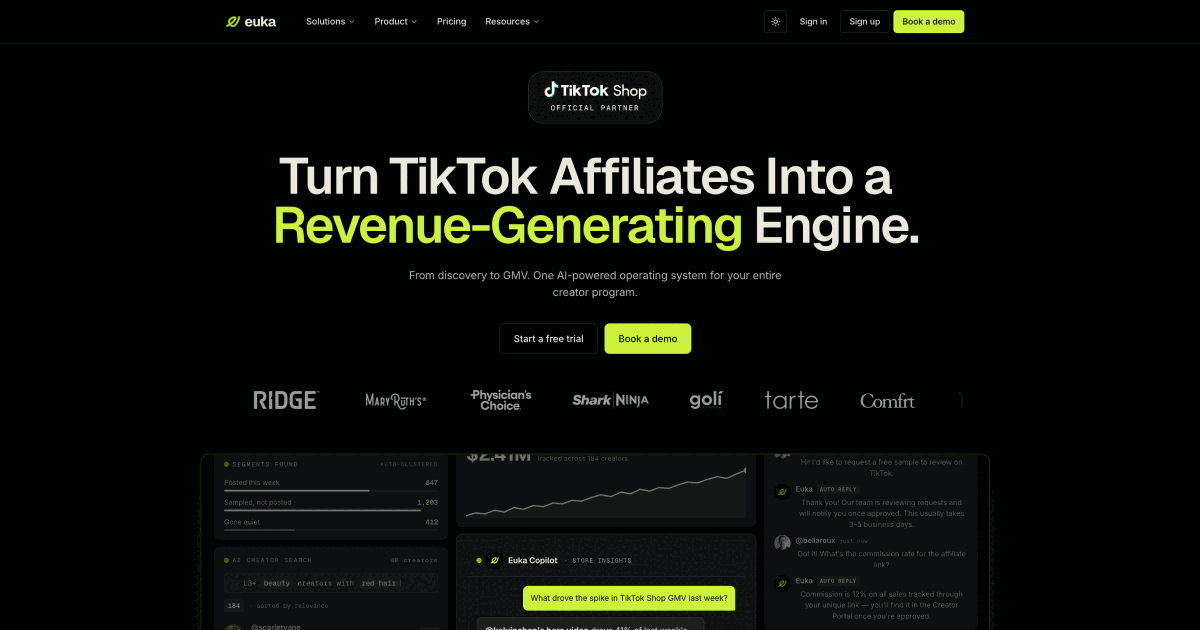
Euka's platform combines creator discovery and vetting, automated outreach, relationship management, sample workflows, affiliate links, order attribution, contests, content-rights management, and payouts. The company also offers tools for moving licensed creator content into Meta advertising and an MCP connection that lets operators query creator-program data through AI tools.
The Instagram and Shopify expansion changes the scope of that system. TikTok Shop brings discovery, content, and transactions close together, while Instagram campaigns and a brand's Shopify store split those functions across different systems. Euka is betting that brands will value a shared operating layer more as the buying journey stretches across them.
The company reports that its software has driven more than $4B in GMV for more than 17,000 brands or stores and that it indexes over 4M creators. Euka also says 55,000 creators use its creator app, it supports affiliate operations for 6 of the top 10 TikTok Shop brands, and it received a 2026 TikTok Shop Catalyst Award for driving the highest incremental GMV increase for brands.
Those figures describe company-reported scale, not an independent audit of Euka's revenue, retention, margins, or attribution accuracy. They still matter because they show the size of the workflow Euka is trying to standardize. A system touching that many relationships has to do more than find creators; it has to preserve the commercial record around what each relationship produces.
Why Attribution Becomes the Product
Creator marketing software often begins with discovery because finding the right person is easy to demonstrate. The harder business work starts after the introduction: a product has to ship, a creator has to post, rights may need to be negotiated, content may move into paid media, orders must be attributed, and commissions must be calculated and paid.
Each additional platform creates another identity, content policy, data model, and checkout path. A creator who performs on TikTok Shop may also publish on Instagram, send traffic to Shopify, and license content for Meta ads. If the brand cannot connect those activities to one relationship and one financial record, the program produces more media while its operating truth becomes harder to see.
Euka's cross-platform pitch is therefore less about adding another channel tab and more about maintaining continuity. Brands need to know whether a creator relationship remains profitable, compliant, and payable when content and transactions leave the platform where the relationship began. That is a software problem with a human at both ends of it.
What the Seed Round Has to Prove
The financing gives Euka more room to expand its platform, but the public announcement does not specify how the $5M will be allocated. Product expansion is visible in the Instagram and Shopify launch and the planned YouTube integration; a precise hiring, sales, or infrastructure budget is not.
The commercial test is whether Euka can make cross-platform breadth feel simpler rather than merely larger. A unified dashboard is useful, but brands ultimately need reliable attribution, rights status, fulfillment state, and payout records. Creators need clear opportunities, manageable approvals, and accurate compensation without becoming rows inside an outreach machine.
Susa Ventures and Creator Ventures are underwriting Euka at the point where creator commerce is becoming an operating discipline. Their bet depends on Euka converting company-reported reach into durable workflow ownership while the social platforms retain enormous control over discovery, data access, and product rules.
The Broader Creator-Commerce Shift
Brands once treated creator programs as a collection of campaigns. The largest programs now resemble distributed sales organizations, except the sellers are independent, the content is the storefront, and the transaction may finish on a different platform from the one that created demand.
That shift rewards software that can carry context across the handoffs. The valuable record includes the creator's history, content rights, products sampled, links issued, orders attributed, commissions owed, and the next action required. It becomes infrastructure when losing that record changes revenue, customer acquisition costs, or trust with the people producing the demand.
Euka's $5M disclosure places the company directly inside that transition. Its next stage will be measured in the space between a creator post and a reconciled payout, where platform expansion either becomes one coherent operating system or another pile of dashboards waiting for someone to make them agree.
Frequently Asked Questions
Why is Euka expanding beyond TikTok Shop?
Euka is trying to give brands one operating record for creator relationships, content, attribution, orders, and payouts across multiple channels. Its Instagram integration connects creator campaigns with Shopify fulfillment, and the company says YouTube support is planned.
What does Euka AI do for brands and creators?
Euka combines creator discovery, vetting, automated outreach, CRM, samples, affiliate links, order attribution, content workflows, rights management, contests, and payouts. The company also offers a creator app and tools for reusing licensed content in Meta advertising.
Which investors backed Euka's $5M seed round?
The disclosed $5M seed financing was led by Susa Ventures and Creator Ventures. Euka disclosed the previously raised round on September 17, 2026, but public sources do not state the exact close date, valuation, security, or ownership terms.
What should operators watch as Euka becomes cross-platform?
The key test is whether Euka can preserve reliable identity, content-rights, fulfillment, attribution, and payout records as creator activity moves across TikTok Shop, Instagram, Shopify, Meta advertising, and eventually YouTube. Cross-platform breadth matters only if the operating record stays coherent.
Where the Money Moved
The intelligence briefing of the innovation economy. Funding, M&A, debt and fund closes, read as market signal rather than deal announcements.
Subscribe to Where the Money Moved