


Subconscious Builds the Inference Layer for AI Agents
Subconscious is a Cambridge, Massachusetts AI infrastructure company building an inference platform for long-running agents. Founded in 2025 by CEO Jack O'Brien and CTO Hongyin Luo, the company focuses on a problem that becomes obvious only after an agent stops behaving like a chatbot: its history gets heavy.
The platform serves coding agents, product agents, and enterprise workloads through a managed API and self-hosted deployments. Subconscious uses runtime context compression and cache reuse to reduce the repeated processing that can make long traces slower, more expensive, and harder to keep inside GPU memory.
That places Subconscious in an increasingly important layer of the AI stack. As agents take more steps and use more tools, model choice matters, but the serving system starts deciding how much useful work each GPU and each dollar can buy.
About Subconscious
Subconscious emerged from MIT research and is headquartered in Cambridge. The company describes its mission as helping people automate monotonous work while keeping models accessible, affordable, and private. That mission shows up in the product architecture: open models, a hosted inference API, and an enterprise option that runs inside a customer's cloud.
The company targets 3 overlapping markets. Developers can point coding agents such as Claude Code, Codex, Cursor, OpenCode, Copilot, and Pi at the Subconscious API. Product teams can use OpenAI- and Anthropic-compatible interfaces for agentic applications. Enterprises can license the runtime for dedicated or on-premises GPU infrastructure.
Subconscious calls the models served on its managed platform "Marathon" models. The name is not decoration. It identifies an operating thesis that agent workloads should be optimized for hundreds of steps and millions of tokens, not treated as extra-long chat sessions.
The Problem Subconscious Is Solving
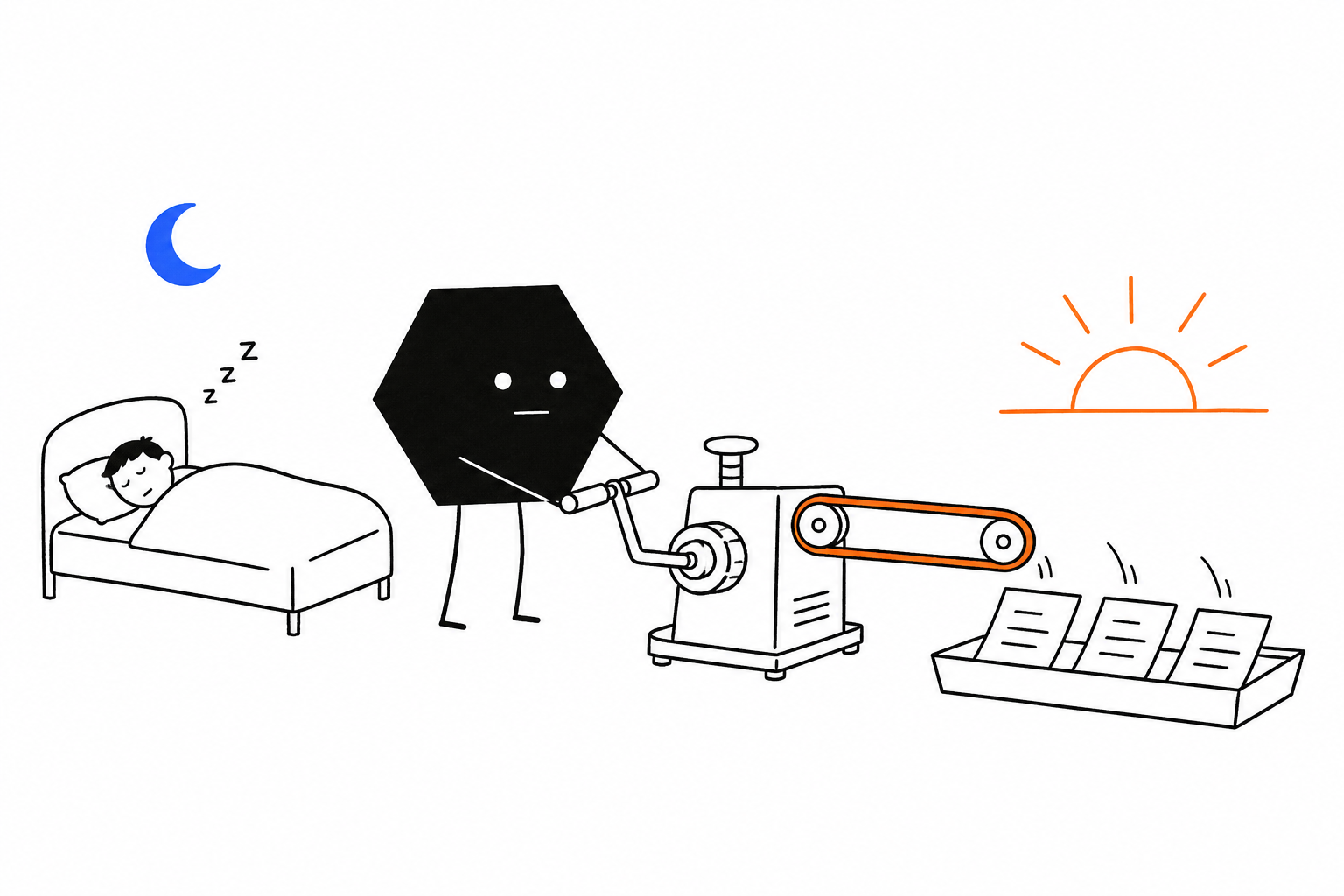
Long-running agents create an accumulation problem. Every tool call, result, correction, and abandoned path can remain in the working context. A general-purpose inference engine may keep attending to that growing history, even when parts of it no longer help the task. The agent then pays a tax in memory, latency, and token processing for work it already finished.
Subconscious attacks that tax at the runtime layer. Its OrangeLine system compresses less relevant context on the GPU, reuses cached prefixes and suffixes around pruned spans, and frees memory while a trace is still running. Its RedLine system post-trains open models on long, tool-heavy trajectories so the models learn to work with the runtime rather than fight the context window.
The distinction matters. Application frameworks can summarize messages or split a task across agents, but those choices happen above the serving layer. Subconscious is trying to make context management part of inference itself, where memory allocation, cache behavior, concurrency, and token throughput are controlled.
What the Performance Evidence Shows
Subconscious reports more than 50% lower cost on long tasks, up to 2x faster task completion, and effective context beyond 5M tokens. The company also reports 2.3x more concurrent workloads and 3.5x faster token generation in selected comparisons with SGLang on identical models and hardware.
Those are company-reported measurements, not an independent audit. The strongest public technical foundation is the 2025 research preview Beyond Context Limits: Subconscious Threads for Long-Horizon Reasoning, which lists Luo and O'Brien among its authors and describes a model-and-runtime approach for retaining relevant working memory during long reasoning processes.
The commercial proof is still developing. Subconscious says its platform is live in production, but it has not disclosed revenue or a customer count. Engineering buyers should test the runtime against their own models, tool patterns, privacy constraints, and failure modes. Benchmark wins are a useful invitation. Production traces decide whether the bill actually changes.
Leadership, Research, and Company Building
O'Brien and Luo bring different halves of the company together. O'Brien's background includes technical and company-building work, while Luo earned an MIT EECS PhD and worked on efficient, structured reasoning in language models. Their shared research appears in the company's early technical record, and their current roles divide the work clearly: O'Brien leads the business as CEO and Luo leads the technical organization as CTO.
The company was founded in 2025 and has raised $5.1M across pre-seed and seed rounds led by MassVentures. DevCuration's Funding Announcement coverage details the round structure, participating investors, and the limits of the company's disclosed performance evidence.
The funding supports a company moving from research preview to operating platform. That transition is where infrastructure startups either become indispensable or become interesting papers with a pricing page. Subconscious now has to prove that context compression and cache reuse survive the messy geometry of real agent workloads.
Why Hiring Momentum Matters
Subconscious's careers page lists openings for inference platform engineering and exceptional candidates who do not fit a standard posting. The company says it values what candidates have built over grades or credentials and describes the hires as additions to a founding team.
That hiring pattern is a market signal, not a recruiting slogan. Subconscious is concentrating headcount where runtime research becomes production infrastructure: inference engineering, machine learning research, systems performance, and platform reliability. The company is betting that the next constraint in agent adoption will be operational, not merely model intelligence.
What Subconscious Signals for AI Infrastructure
AI infrastructure is moving from a single question, which model is best, to a systems question, how much useful work can the whole stack sustain? DevCuration has tracked the same pressure through Positron AI's memory-first inference architecture and Wafer's inference optimization software. Each company attacks a different layer, but all are responding to the cost of turning model capability into dependable throughput.
Subconscious has chosen the agent trace as its unit of economics. If agents become longer-lived, more tool-heavy, and more autonomous, context management stops being housekeeping. It becomes infrastructure.
The opportunity is large because the waste compounds with every step. The risk is equally plain: customers will care less about elegant compression theory than whether their agents finish correctly, securely, and cheaply under load. Subconscious is building for that argument, one long run at a time.
AI Infrastructure funding, last 30 days
DevCuration's funding database tracked 30 AI Infrastructure rounds totaling $16B in disclosed capital over the past 30 days. Recent deals we covered:
- Subconscious Raises $5.1M for Long-Running AI AgentsPre-Seed and Seed · $5.1M · Sep 24
- Bird Secures $450M Debt for Agentic CommunicationsDebt · $450M · Sep 24
- Snorkel AI Raises $350M Series E for Frontier AI DataSeries E · $350M · Sep 23
- Firecrawl Raises $75M for Alexandria AI Knowledge LibrarySeries B · $75M · Sep 22
- NVIDIA Anchors Brookfield AI Fund With $2B CommitmentFund Commitment · $2B · Sep 21
Frequently Asked Questions
What does Subconscious do?
Subconscious builds inference infrastructure for long-running AI agents. Its platform manages context, caching, and GPU memory so agents can run longer with lower cost and latency.
Who founded Subconscious?
Subconscious was founded in 2025 by Jack O'Brien, co-founder and CEO, and Hongyin Luo, co-founder and CTO.
What are OrangeLine and RedLine?
OrangeLine is Subconscious's inference runtime for managing context and cache during long agent runs. RedLine is its post-training system for open models on long, tool-heavy trajectories.
Who uses Subconscious?
Subconscious serves developers running coding agents, software teams building agentic products, and enterprises that want dedicated or self-hosted inference infrastructure.
Is Subconscious hiring?
Yes. Its careers page lists inference-platform engineering and general exceptional-candidate roles for a small Cambridge team.
Where the Money Moved
The intelligence briefing of the innovation economy. Funding, M&A, debt and fund closes, read as market signal rather than deal announcements.
Subscribe to Where the Money Moved