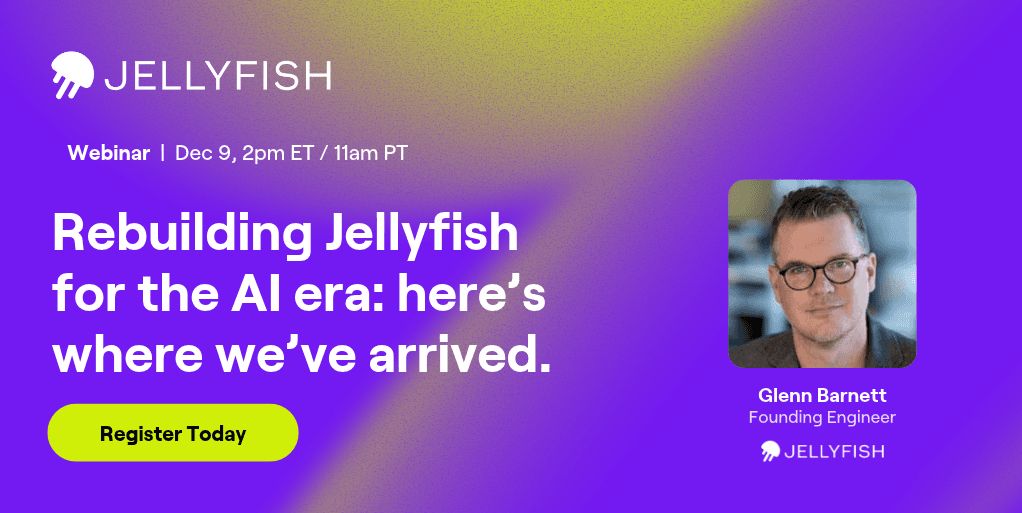
Jellyfish will host an online webinar on December 9, 2026, at 2 PM ET, with Glenn Barnett, its founding engineer, examining the company’s ongoing AI-era platform rebuild. The 1-hour session gives engineering leaders a concrete setting for a difficult question: how do you explain the work when agents, people and systems leave different records of the same effort?
The official event page describes architecture, event streams and connections across Jira, Azure DevOps and Linear as discussion topics. The wider significance is the reporting burden that accompanies AI-assisted development. A business still needs to know what an engineering investment accomplished, even when its activity has become harder to follow.
Engineering activity needs a business explanation
A ticket is useful because it gives work a recognizable container. Someone can assign it, review its status and connect it to a planned outcome. Trouble begins when a manager assumes every relevant action fits neatly inside that container, especially when automated work crosses tools or creates additional review. A count may be accurate within one system and still give an incomplete account of the effort behind a release.
That is an operating problem with commercial consequences. A product leader deciding where to invest engineering capacity needs an explanation of what the work served. A team lead needs to understand where attention and judgment were required. If both people receive a larger number with little context, they inherit a new reporting task: reconstructing the relationship between recorded activity and useful progress.
Jellyfish’s historical explanation of engineering allocation provides context for that distinction. The company describes allocation as a way to understand how engineering effort is distributed across strategic priorities. Applied to AI-assisted work, the editorial question becomes whether the available records still support those decisions. Leaders have to decide which relationships deserve confidence before those relationships appear in a budget presentation.
What a broader data model has to carry
Jellyfish’s current Data Hub materials describe configurable metrics and dashboards that combine engineering signals. Those are the vendor’s descriptions of its product, rather than independent findings about customer outcomes. They establish why the underlying data model matters: the same measurements may need to serve team-level investigation and an executive’s much broader account of delivery.
Consider the questions an engineering organization might bring to such a model. When several records refer to the same work, how are those records connected? When context is missing, does the report make that gap visible? When a definition changes, can the organization explain why this month’s measurement differs from last month’s? These are evaluation questions, not claims about a particular Jellyfish implementation.
Each question reaches beyond data collection. A manager may be comfortable using an imperfect signal to spot a bottleneck while being much less comfortable using it to evaluate an individual. Making that distinction explicit helps keep a dashboard’s apparent precision from acquiring authority its inputs cannot support. The ability to investigate a number can matter as much as the convenience of displaying it.
Integration breadth raises questions about meaning
Jellyfish’s integration catalog spans issue tracking, source control, delivery systems and AI tooling. It lists connections involving Jira, GitHub, Linear and Azure DevOps alongside AI products. This breadth illustrates the practical environment the company is trying to describe, with different systems contributing different parts of the engineering record.
Connecting those sources creates a semantic problem as well as a transport problem. A team needs to know what each incoming record means in its own workflow and how that meaning changes when records are combined. An accepted code change, for example, may answer a different management question from a completed product initiative. The interpretation requires an explicit purpose, rather than an assumption that more visible activity automatically means more delivered value.
For engineering executives assessing software intelligence tools, that suggests a useful preparation exercise. Choose one recent piece of work and identify the systems needed to explain it. Note where a person supplied missing context, where review occurred and where the work’s business purpose became clear. An architecture discussion becomes easier to evaluate when the listener has a specific reporting difficulty in mind.
AI adoption puts existing systems under pressure
Independent context comes from the 2025 DORA research, which characterizes AI as an amplifier of an organization’s existing strengths and weaknesses. The research emphasizes the surrounding organizational system in realizing returns from AI. It supplies a broader reason to examine engineering practices and information quality; it is not an evaluation of Jellyfish or an endorsement of this webinar.
For operators, that framing shifts attention toward the conditions under which a measurement becomes useful. A team can ask whether its definitions are shared, whether people understand how information is collected and whether the resulting report helps someone make a better decision. Tool adoption introduces additional information, but the organization still has to decide how to interpret and act on it.
The human handoff deserves particular attention. If an automated contribution reaches a reviewer without enough context, someone must rebuild that context before accepting the work. An account of engineering productivity should leave room for that judgment. Otherwise, the organization risks recognizing the easiest activity to count while overlooking the effort that makes the contribution usable.
A rebuild has to coexist with the running product
The migration angle gives this session relevance beyond teams currently evaluating Jellyfish. For any established product, architectural change must be reconciled with the people relying on its current behavior. An engineering organization considering similar work can listen for how design choices preserve continuity, how definitions remain understandable and how an evolving system makes its limitations visible.
Platform engineers and data leaders are therefore likely to find the most value in specific trade-off discussions. Engineering executives can listen for the reporting consequences, while product and finance counterparts can examine how the resulting information supports decisions about capacity and investment. These are assessments of who may benefit, not a confirmed attendee list or a promise of networking access.
Registration information is available through Jellyfish’s event page. The published listing does not establish a fee, a named moderator, a recording policy or a networking format. As Glenn Barnett walks through the rebuild, the useful details for listeners will be the ones they can carry into their next discussion with a team whose work already crosses more systems than its reporting comfortably explains.
 Jellyfish’s AI Platform Rebuild: Inside the December Webinar|Iconic Raises $10M Seed for Capital Project Intelligence|Hadrian Buys Kutztown Foundry, Plans $300M Expansion|Cary Group Deal: CPP, Ontario Teachers Join Nordic Capital|General Flash Raises $128M to Scale U.S. Critical Metals|Genesis AI Raises $500M Series A for Eno Robot Deployment|Earthly Raises $5.7M to Scale Lunar Engineering Guardrails|
 Valkryn Raises $15M Seed for Autonomous Defense Testing|Alumni Ventures Puts Consumer AI Agents Under the Microscope|Propel Earth Puts Family Offices and Founders in One Room|