




Bulwark Dynamics Raises $6.8M for Autonomous Landing Craft
A landing craft can cross miles of contested water and still fail where the cargo must meet the beach. Bulwark Dynamics is financing that last handoff with a $6.8M Seed round to develop and produce its Caravel autonomous landing craft.
The September 9, 2026 round includes SBI US Gateway Fund LP, Archetype Ventures, Nēnē Ventures, and Onomichi Dockyard among its investors. The money will support Caravel development and production, new manufacturing capacity, operational testing, and hiring in the United States and Japan.
Bulwark also signed a memorandum of understanding with Onomichi Dockyard to work toward serial production of the Caravel series in Japan. That manufacturing agreement is the strategic center of the announcement because it connects hull design, autonomy, cargo handling, operational testing, and allied shipyard capacity before a customer asks whether the system can exist in useful numbers.
What Happened
The $6.8M Seed announcement names 4 investors but does not identify a lead, valuation, ownership structure, or financing terms. The release says the group includes SBI US Gateway Fund LP, Archetype Ventures, Nēnē Ventures, and Onomichi Dockyard, leaving open whether additional investors participated.
Bulwark’s own site records an undisclosed pre-seed round in September 2025. That means $6.8M is the verified amount of the current Seed transaction, while the company’s lifetime capital cannot be calculated responsibly from the public record.
The new capital is intended to accelerate the development and production of the Caravel series, establish manufacturing capacity, and test vessels in operationally representative environments. Bulwark also says it is hiring across engineering, test operations, and business development at its U.S. and Japan locations.
The Last Hundred Yards of Maritime Autonomy
Bulwark was founded in 2025 and is headquartered in Menlo Park, California, with Tokyo operations described in the funding announcement. Its current leadership page lists Nhat Lieu as founder and CEO, Yuta Shiina as co-founder and CTO, and Isaac Anderson as co-founder and lead engineer.
The company’s product thesis begins where many autonomous maritime systems stop. Caravel is designed to transit through shallow water, land on an unimproved beach, discharge cargo, and retract without a port, pier, crane, or exposed shore crew. Bulwark also describes GPS-denied navigation and container-compatible cargo handling as core capabilities.
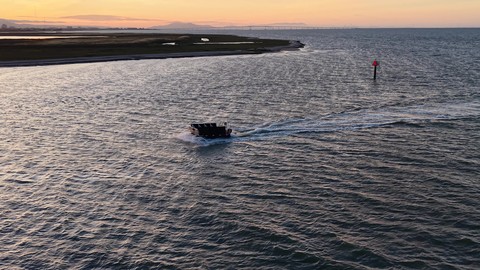
Bulwark and Tectonic Defense report that a 15-foot Caravel prototype completed an unmanned mission sequence in early 2026, including transit, beaching, cargo offload, and retraction. The company is developing 35-foot and 55-foot variants intended for larger containerized loads, but performance specifications and production targets remain company-reported rather than independently audited.
Why Manufacturing Is Part of the Product
An autonomous craft can demonstrate navigation and still fail as a logistics system. The hull must be produced consistently, the cargo system must work without specialized shore infrastructure, and the vessel must be serviceable in the operating region. For defense buyers, those questions sit beside autonomy software rather than after it.
Onomichi Dockyard gives the financing story an industrial dimension. The Japanese company was established in 1943 and operates shipbuilding and repair businesses with production facilities in western Japan. Under the MOU, Onomichi and Bulwark plan to work together on Caravel production in Japan and are discussing a dedicated unmanned-vessel site.
The distinction matters because an MOU documents intent, not a completed production program. Bulwark has not disclosed a purchase order, committed production volume, delivery schedule, or awarded government contract. The partnership creates a path that still has to be validated through design transfer, testing, procurement, and repeatable construction.
The Investor and Policy Logic
The named investor group connects early-stage capital, Pacific defense specialization, and shipbuilding. SBI US Gateway Fund LP is a U.S.-focused early-stage vehicle; Tokyo-based Archetype Ventures backs B2B technology companies; Nēnē Ventures focuses on defense and dual-use companies serving the Indo-Pacific; and Onomichi brings direct industrial participation.
No lead investor was disclosed, so the public record does not support assigning control or ownership of the round to any one participant. The investment logic is visible in the group’s composition, but check sizes, board rights, and individual strategic commitments remain private.
The wider policy environment makes the combination timely. The White House’s America’s Maritime Action Plan calls for more shipbuilding capacity, stronger supplier resilience, and cooperation with allies and partners. That plan provides context for cross-border industrial models, but it does not endorse Bulwark or represent a procurement decision.
What the $6.8M Must Prove
Navy and Marine Corps exercises around Expeditionary Advanced Base Operations show why distributed units need logistics across austere islands and shorelines. Caravel is aimed at that operating problem: reduce dependence on a few large, crewed platforms and fixed ports by spreading cargo movement across smaller autonomous craft.
Bulwark has not disclosed a customer roster, revenue, fielded deployment, or government award. Those omissions do not invalidate the engineering thesis, but they define the work ahead. The company must turn an early demonstration into repeatable performance, translate an MOU into actual manufacturing capability, and make procurement economics work for buyers that measure reliability across fleets rather than demos.
The Seed round gives Bulwark room to test that full chain. Each successful beach landing will matter, but the company’s larger claim will be judged by whether U.S. and Japanese teams can build the same capability repeatedly, move it closer to operators, and keep the logistics mission intact after the novelty of the first prototype is gone.
Frequently Asked Questions
What does Bulwark Dynamics build?
Bulwark Dynamics builds the Caravel series of autonomous landing craft for contested maritime logistics. The vessels are designed to reach unimproved shorelines, discharge cargo, and retract without a port, pier, crane, or exposed shore crew.
How will Bulwark Dynamics use the $6.8M Seed round?
Bulwark says the capital will fund Caravel development and production, manufacturing capacity, operationally representative testing, and hiring across U.S. and Japan operations. The company did not disclose a valuation or financing terms.
Who invested in Bulwark Dynamics?
The announcement names SBI US Gateway Fund LP, Archetype Ventures, Nēnē Ventures, and Onomichi Dockyard among the investors. It does not identify a lead investor or say that the public list is exhaustive.
What is the Onomichi Dockyard partnership?
Bulwark and Onomichi Dockyard signed an MOU to work toward serial production of the Caravel series in Japan. They are also discussing a dedicated site for unmanned-vessel production, but no purchase order, production volume, or delivery schedule was disclosed.
What must Bulwark prove after the Seed round?
Bulwark must translate an early autonomous mission demonstration into repeatable operational performance and repeatable manufacturing. The public record does not yet disclose customer orders, government awards, fielded deployments, or independently audited performance.
Where the Money Moved
The intelligence briefing of the innovation economy. Funding, M&A, debt and fund closes, read as market signal rather than deal announcements.
Subscribe to Where the Money Moved